

How Physique Athletes Really Train: Weekly Volume by Muscle Group in Off-Season vs. Contest Prep
Understanding how competitive physique athletes structure their training is one of the most important questions in bodybuilding. While theory suggests that training volume is a key driver of hypertrophy, the actual week-to-week training patterns of athletes across the competitive season have rarely been documented—until now.
A new 2025 study by Beraldo and colleagues provides rare insights into how physique athletes train across different divisions and phases of the year. Unlike controlled laboratory studies that focus on a small number of exercises, this research collected real-world training data from bodybuilders and physique athletes. The result is a unique snapshot of how resistance training volume and cardio shift between the off-season and contest prep.
Background: why training volume matters
Training volume, typically defined as the number of working sets per muscle group per week, is one of the most discussed variables in resistance training programming. Research has shown that higher volumes, within reason, can promote greater hypertrophy.
Physique athletes face unique challenges. During contest prep, they must maintain muscle while cutting body fat, managing fatigue, and recovering in a calorie deficit. Different divisions place different emphasis on muscle groups. Classic Bodybuilding may reward pec and shoulder development, while Bikini and Wellness divisions place more emphasis on glutes and shoulders.
Despite years of theory and coaching advice, little actual data existed on how athletes in different divisions train in the off-season versus prep. Most resistance training studies are limited in scope, often testing only two or three exercises such as squats, leg presses, or leg extensions to represent lower body training. For example, Schoenfeld et al. (2018) capped their analysis at knee extensions, barbell squats, and leg press, while Enes et al. tested very high weekly set volumes (up to 52) using only three exercises.
This leaves out crucial elements of bodybuilding training—hamstring work, glute isolation, and accessory movements such as hip abductions or kickbacks—that athletes rely on to refine their physiques. The Beraldo et al. (2025) study aimed to fill this gap by systematically quantifying weekly training volume across ten muscle groups.
Purpose of the study
The primary aim was to quantify and compare weekly resistance training volume per muscle group during the off-season and pre-contest phases. Secondary aims included examining differences between men’s and women’s divisions and tracking cardio frequency and duration across training phases. The goal was to provide a division-specific snapshot of how athletes balance training, recovery, and conditioning demands throughout the year.
Methods
This was a cross-sectional, survey-based study involving competitive physique athletes from multiple federations, including the IFBB Elite Pro, NPC, WNBF, NABBA, and others.
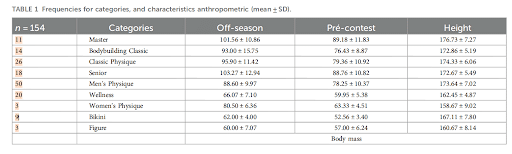
Athletes reported training data for both their off-season and contest prep periods. The survey captured the number of exercises performed per muscle group, the average number of sets per exercise, and the weekly frequency of training for each muscle group.
Weekly training volume was calculated using the formula:
Exercises × Sets × Frequency = Weekly Training Volume
The analysis included ten muscle groups: pectorals, deltoids, latissimus dorsi, biceps, triceps, quadriceps, hamstrings, gluteals, calves, and abdominals.
Cardio training was also documented, including both frequency and average duration per session.
Results
Overall training trends: Resistance training volume was consistently higher in the off-season compared to contest prep. Cardio volume increased sharply during prep, with more sessions of longer duration. The trade-off was slightly less lifting and much more cardio.
Muscle group trends: Quadriceps and hamstrings were among the highest-volume muscle groups, especially in the off-season. Calves and abdominals consistently received low training volume. Nearly all muscle groups experienced reduced training volume in contest prep, with the steepest reductions in quadriceps and chest. Biceps and triceps remained consistent, but at lower volumes compared to larger muscle groups.
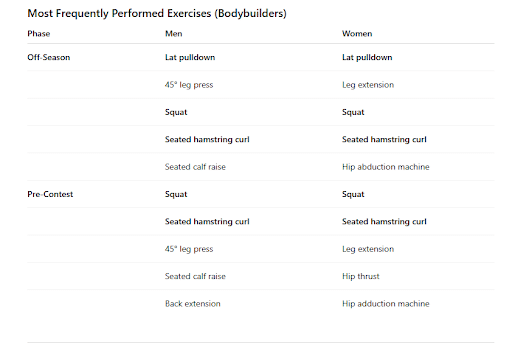
Exercise selection in men: During the off-season, the most common exercises were lat pulldowns, squats, 45° leg press, seated hamstring curls, and seated calf raises. During contest prep, the most frequent exercises were squats, seated hamstring curls, 45° leg press, back extensions, and seated calf raises.
Exercise selection in women: During the off-season, the most common exercises were seated hamstring curls, squats, leg extensions, lat pulldowns, and hip abduction machine. During contest prep, squats, seated hamstring curls, leg extensions, hip thrusts, and hip adduction machine were prioritized.
Division-specific insights: Bikini athletes reported the lowest overall training volumes. Shoulder sets doubled from approximately 7.5 in the off-season to 15 in prep, while glute sets decreased from 31 to 15. Wellness athletes consistently maintained 24 weekly glute sets across both phases. Classic Physique men reported the highest glute volumes among male divisions, with 12 weekly sets in both phases.
Interpretation
The findings suggest that contest prep is marked by selective reductions in resistance training volume, especially for large upper-body muscles in men, combined with a substantial increase in cardio.
Off-season training placed more emphasis on division-specific aesthetics. For example, Classic Bodybuilding favored higher pec and delt volumes, while Bikini and Wellness competitors maintained high glute focus.
These reported volumes provide valuable benchmarks but should not be mistaken for “optimal.” The study shows how athletes allocate training in practice, but individualization remains key.
Conclusion
Weekly training volume in physique athletes is tailored to both the season phase and the division’s judging criteria. The off-season prioritizes building muscle with higher resistance volumes, while contest prep shifts toward maintaining muscle and increasing cardio.
The study by Beraldo et al. (2025) is one of the first to capture real-world programming at scale, offering both researchers and practitioners a clearer view of how athletes actually train.
Want to follow evidence-based programs designed for physique athletes? Check out my Road to Worlds, Ms. Bikini Olympia, or Pro Fitness Model programs — just $12.99 each → https://shop.bia-body.com/collections/training-programs
Frequently Asked Questions
How many sets do physique athletes do per week?
According to Beraldo et al. (2025), weekly training volume varies by muscle group and division, but many physique athletes report between 15–30 weekly sets for larger muscles like the quads, glutes, and hamstrings during the off-season. Smaller muscle groups such as biceps and calves often receive less, in the range of 7–12 sets.
Do physique athletes train less during contest prep?
Yes. Across divisions, resistance training volume tends to decrease during contest prep. This reduction helps athletes manage fatigue and recovery while in a calorie deficit. At the same time, cardio training usually increases in both frequency and duration.
Which muscles get the most training volume?
Quads, hamstrings, and glutes typically receive the highest training volumes. Glute training is especially prioritized in Bikini and Wellness divisions, while pecs and delts receive greater emphasis in Classic Bodybuilding.
Why do Bikini athletes have lower training volumes than other divisions?
Bikini competitors reported some of the lowest total weekly set volumes in the Beraldo et al. (2025) study. This reflects the judging criteria of the division, which emphasizes balance, symmetry, and lower levels of muscularity compared to Classic or Wellness categories.
How accurate is self-reported training data?
Self-reported surveys provide valuable insight into real-world training practices, but they rely on athletes accurately recalling and reporting their programs. These results show what athletes are doing, not necessarily what is optimal for muscle growth.

Holly T. Baxter is an Australian Dietitian with over 13 years of experience in health and fitness. She holds a degree in Food Science and Nutrition and a Master of Dietetics from Deakin University. A former professional physique athlete, Holly has two World Championship titles. Her latest project, BiaBody, is dedicated to women’s health and fitness. As an APD Dietitian and Online Physique Coach, she focuses on evidence-based health education and empowering women through fitness.